
Purim is the holiday that reminds us not to trust what we see too quickly.
The Megillah never names God, yet God is everywhere. Esther lives hidden in the palace, her true identity concealed until the moment it matters most. Haman believes he is ascending even as the ground is already giving way beneath him. The entire story turns on reversals—v’nahafoch hu—what we think we are seeing is not what is actually happening.
We dress in costumes not to deceive, but to remember that essence and appearance are rarely the same thing. This is a tension I’ve written about before through Esther and Moses, each discovering their true self while hidden in plain sight.
That same lesson can live on the plate as well.
In recent years, I’ve found myself drawn to food that plays with expectation. Dishes that look like one thing and turn out to be another. Not to fool the eater, but to delight them in the moment of discovery.
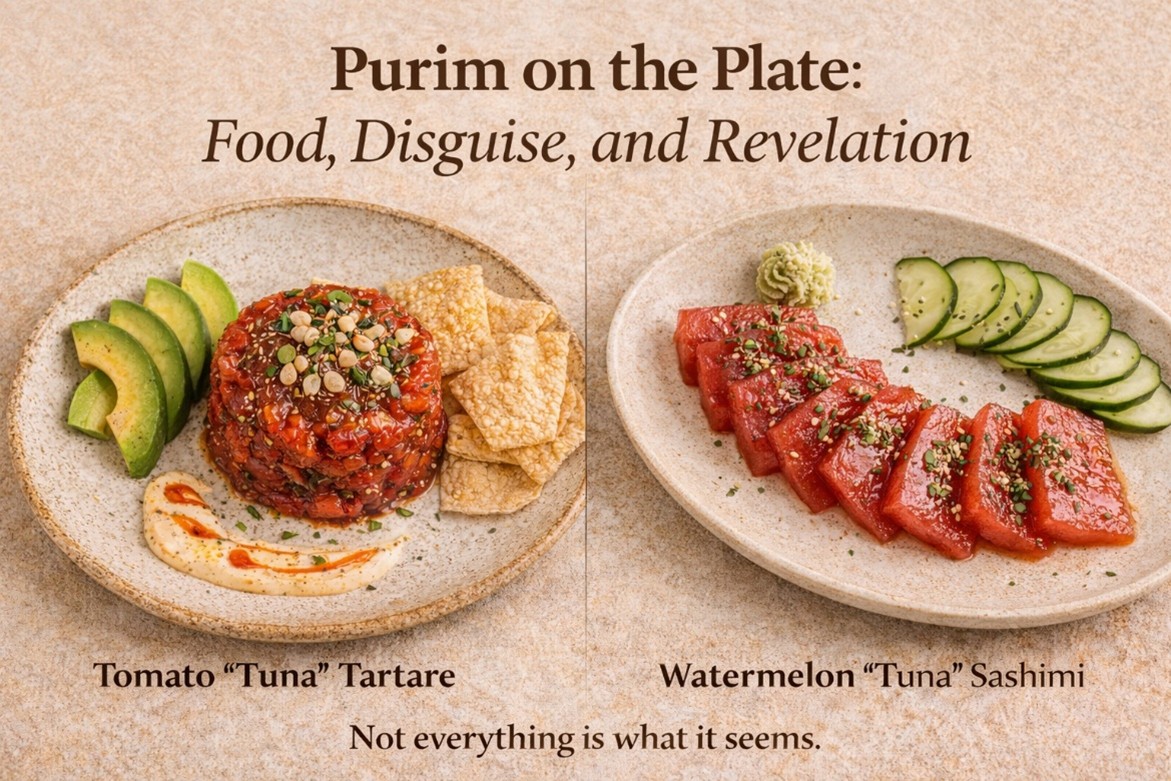
This tomato “tuna” tartare is exactly that. At first glance, it reads unmistakably as tuna: deep red, glossy, finely diced, shaped with intention. But beneath the surface, the truth is entirely different. Carefully prepared tomatoes with their seeds removed so only the firm flesh remains become “tomato meat.” Dates add a soft chew, while seaweed and soy impart umami.
Like Purim, the delight is in the reveal. You taste it expecting one thing and discover something else.
It is not tuna. Yet it carries the memory of tuna—its color, its structure, its elegance—without being bound to it. That freedom is the point.
The same is true of watermelon “tuna” sashimi. When sliced and treated with restraint, watermelon takes on the appearance and even the mouthfeel of raw fish. It stops conversation. People lean in. Then comes the smile. The recognition that what they thought they knew is being gently overturned.
Both dishes naturally belong on a Purim table because Purim is not about certainty; it is about revelation. About the slow uncovering of what has been hidden in plain sight.
Food like this does not mock tradition but honors it. It says: the story is still alive. We are still allowed to play. Still allowed to be surprised.
On Purim, we give gifts of food—mishloach manot—not because sustenance is scarce, but because connection is. These dishes carry curiosity. They spark conversation. They invite laughter.
Purim does not ask us to abandon truth. It asks us to approach it sideways.
Sometimes the most honest thing at the table is the dish that looks like something else entirely.
Chag Purim Sameach.