
“Did Dad wake up?”
I typed that question into our family text thread and stared at it. It sounded like a question about a newborn.You stand over the crib, a hand close to the tiny face, feeling for breath. Is he breathing? Will he wake up?
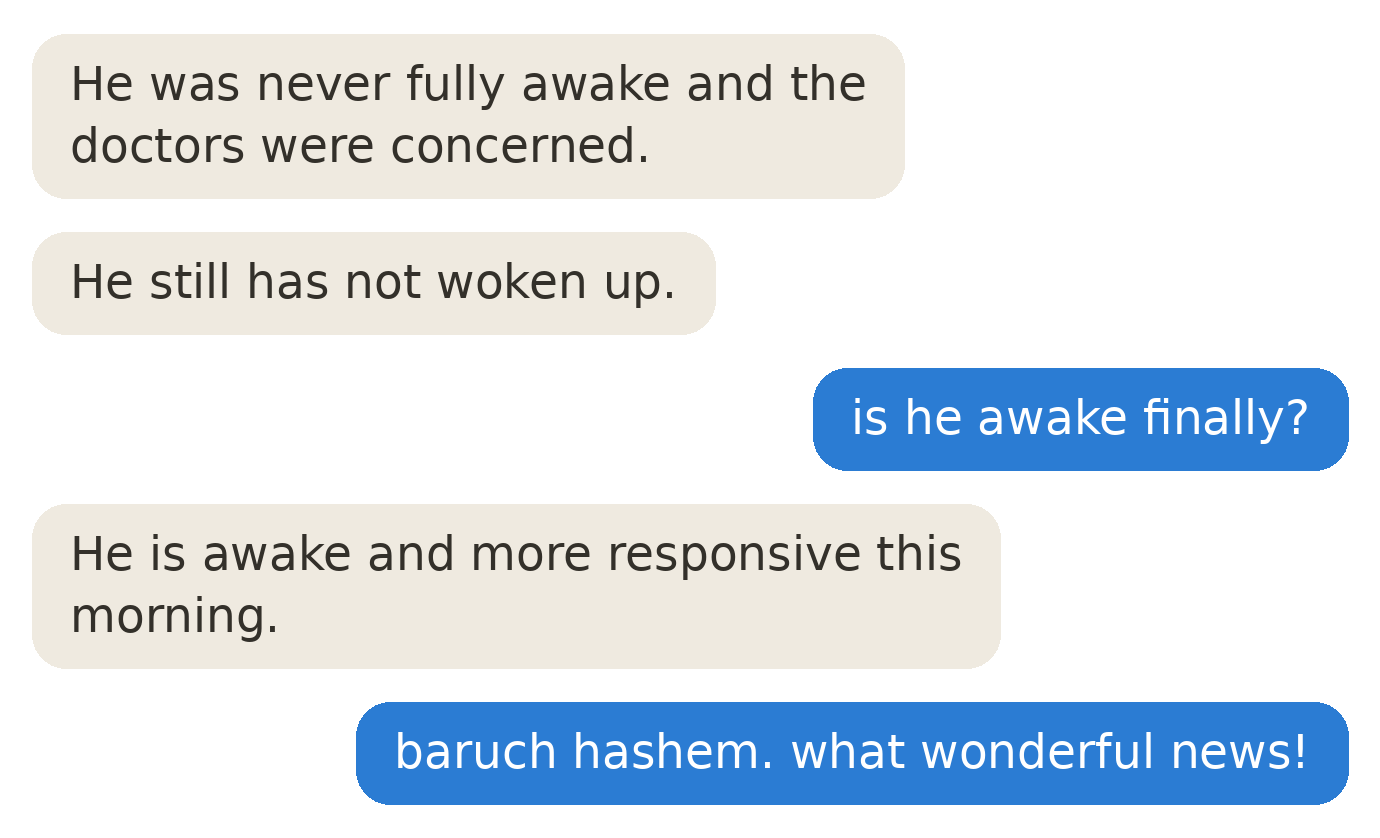
My dad is 91. This month he had a long operation, and for three days afterward, he did not wake up. The updates came a few lines at a time. My dad’s wife, Sandy, sat vigilantly at his bedside and sent each update. “He was never fully awake and the doctors were concerned.” “No, he is not fully awake.” “He still has not woken up.” Each morning my brothers and I asked the same question differently: Is he awake finally? How is our Dad?
On the fourth morning: “He is awake and more responsive this morning. They are going to move him out of ICU some time today.”
Baruch Hashem. What wonderful news!
Then the next question rose up in me, typed before I knew I was asking it: Did Dad recognize you?
First, we waited for him to wake. Then we waited for recognition, for Dad to be our Dad again.
During those three days, I had turned to my older daughter Caroline. A medical resident now, she called the hospital and spoke to her grandfather’s medical team. I asked her the question I was almost afraid to ask: “Caroline, is Gramps in a coma?” No, she explained. Gramps was under sedation because of the pain and agitation he felt as the anesthesia wore off. His vital signs were strong, and the team was watching them closely.
It was not a conversation I ever expected to have with my daughter. I was proud of her. When I told my dad later, he was proud of her too.
During those days, I kept asking what it really means to wake up.
Holiness is all around us
That question led me to Vayetzei, the Torah portion we read this past Shabbat. It opens with the Bible’s great waking: Jacob, running for his life, asleep, a stone for a pillow, dreaming of a ladder to heaven. Then the verse: “Jacob awoke from his sleep and said: Surely God is in this place, and I did not know it” (Genesis 28:16).
What strikes me is the word Jacob uses for that place: makom. The rabbis made it one of God’s names, HaMakom, because God is the place of the world (Bereshit Rabbah 68:9). Jacob had been sleeping inside the word for God.
Henry David Thoreau wrote that we must learn to reawaken and keep ourselves awake by an infinite expectation of the dawn, which does not forsake us in our soundest sleep. The holy place, the people at the bedside: they were there all along.
What wakes us
Sometimes it is a storm. Jonah slept below deck while the sea raged, and the captain came to him: “How can you sleep? Kum, arise, call upon your God!” (Jonah 1:6). But sometimes it is gentle. Elijah, despairing, lay down in the wilderness and slept, and an angel touched him and said the same word: kum, arise and eat. The captain shouted it into a storm; the angel brought it with bread, twice. Later, at Horeb, the presence came not in wind, earthquake, or fire, but in a kol demamah dakah, a still, small voice (1 Kings 19:5 to 12). So often what wakes us is quiet: a touch, a call, a family text group, a visit, and just sitting quietly in prayer.
And that is what Sandy and my brothers and I did. Sandy was Dad’s angel, the gentle touch at his bedside. In our text thread, one brother wrote: “I can be there Wednesday morning.” Another: “We will come next Saturday afternoon.” And me: “I will come sooner.” None of us could wake Dad. That was not in our hands. But we could do the one thing that was in our hands: we could show up.
My new beginning
The Talmud calls sleep one-sixtieth of death (Berakhot 57b). That teaching now gives new meaning to Modeh Ani, the prayer traditionally recited upon waking: “I give thanks before You, living and eternal King, for You have returned my soul to me with compassion; great is Your faithfulness.”
Although I had heard of this prayer before, it had not been part of my ritual. I did not understand the reason or believe in the purpose.
Now I do.
Each morning, as I now say Modeh Ani, I thank my dad for teaching me this simple gift of daily gratitude.
***
Three mornings we asked
if Dad had opened his eyes.
Light climbing the wall.
***
Torah, Midrash, and Further Study
A few of the Torah passages, Jewish sources, and other readings behind this essay, for anyone who would like to read further.
Parashat Vayetzei, Bereshit (Genesis) 28:10 to 17. Jacob flees, sleeps with a stone for a pillow, and dreams of a ladder reaching to heaven. He wakes and says, “Surely God is in this place, and I did not know it” (28:16).
וַיִּיקַץ יַעֲקֹב מִשְּׁנָתוֹ וַיֹּאמֶר אָכֵן יֵשׁ יְהֹוָה בַּמָּקוֹם הַזֶּה וְאָנֹכִי לֹא יָדָעְתִּי
And Jacob awaked out of his sleep, and he said: “Surely the LORD is in this place; and I knew it not.” (28:16)
Bereshit Rabbah 68:9. Why is God called HaMakom, the Place?
Because God is the place of the world, and the world is not God’s place. The rabbis read it from Jacob’s word makom at Bethel, a word that appears three times in a single verse, Bereshit 28:11, before Jacob ever lies down.
Yonah (Jonah) 1:6. As the storm rages, the ship’s captain comes to the sleeping Jonah.
וַיִּקְרַ֚ב אֵלָיו֙ רַ֣ב הַֽחֹבֵ֔ל וַיֹּ֥אמֶר ל֖וֹ מַה־לְּךָ֣ נִרְדָּ֑ם קוּם קְרָ֣א אֶל־אֱלֹהֶ֔יךָ אוּלַ֞י יִתְעַשֵּׁ֧ת הָֽאֱלֹהִ֛ים לָ֖נוּ וְלֹ֥א נֹאבֵֽד׃
So the shipmaster came to him, and said unto him: “What meanest thou that thou sleepest? arise, call upon thy God, if so be that God will think upon us, that we perish not.”
Melachim I (1 Kings) 19:5 to 12. An angel touches the despairing Elijah twice and tells him the same word the captain used: kum, arise and eat. At Horeb, the presence comes not in wind, earthquake, or fire, but in a kol demamah dakah, a still, small voice. Horeb is another name for Mount Sinai, “the mountain of God.” There Moses first met God at the burning bush (Shemot [Exodus] 3:1 to 5), and there, Moses later reminds Israel, God made the covenant and spoke the Ten Commandments (Devarim [Deuteronomy] 5:2 to 22). Elijah walks forty days and nights to reach it (19:8), returning in despair to the place where Israel first heard God’s voice.
וַיִּשְׁכַּב וַיִּישַׁן תַּחַת רֹתֶם אֶחָד וְהִנֵּה־זֶה מַלְאָךְ נֹגֵעַ בּוֹ וַיֹּאמֶר לוֹ קוּם אֱכוֹל
And he lay down and slept under a broom-tree; and, behold, an angel touched him, and said unto him: “Arise and eat.” (19:5)
וַיָּשָׁב מַלְאַךְ יְהוָה שֵׁנִית וַיִּגַּע־בּוֹ וַיֹּאמֶר קוּם אֱכֹל כִּי רַב מִמְּךָ הַדָּרֶךְ
And the angel of the LORD came again the second time, and touched him, and said: “Arise and eat; because the journey is too great for thee.” (19:7)
At his head. Between the two touches, the angel leaves “a cake baked on the hot stones” at Elijah’s head (19:6). The Hebrew for “at his head” is ְמַרֲאֹׁשָתיו, the same word Bereshit 28:11 uses for where Jacob set his stone. Both sleepers wake to find something holy placed at their heads.
Talmud Bavli, Berakhot 57b. Sleep is one-sixtieth of death.
Modeh Ani. The prayer said upon waking, thanking God for returning the soul with compassion. It first appears in Seder HaYom by Rabbi Moshe ben Machir of Safed, printed in 1599.
מוֹדֶה אֲנִי לְפָנֶיךָ מֶלֶךְ חַי וְקַיָּם, שֶׁהֶחֱזַרְתָּ בִּי נִשְׁמָתִי בְּחֶמְלָה. רַבָּה אֱמוּנָתֶךָ
Modeh ani lefanecha, Melech chai v’kayam, shehechezarta bi nishmati b’chemlah, rabbah emunatecha.
I give thanks before You, living and eternal King, for You have returned my soul to me with compassion; great is Your faithfulness. (A woman says Modah ani.)
Henry David Thoreau, Walden (1854), “Where I Lived, and What I Lived For.” “We must learn to reawaken and keep ourselves awake, not by mechanical aids, but by an infinite expectation of the dawn, which does not forsake us in our soundest sleep.”
More from Breaking Matzo. Living Life on the Ladder: How Planning for “Nothing” Can Bring “Everything” (2020). An earlier Breaking Matzo essay on Jacob’s ladder (Bereshit 28:10 to 19): the angels go up and down, and growth happens in the open space between our commitments.
Share This Blog
If this blog spoke to you, please pass it along. Share the link or simply tell someone about it.
Share on social: @breakingmatzo (Instagram & Facebook)
Subscribe to Breaking Matzo
New to Breaking Matzo? Join 40,000 readers who receive each new essay in their inbox.
Subscribe at: breakingmatzo.com
Questions or thoughts? Write to us: contact@breakingmatzo.com