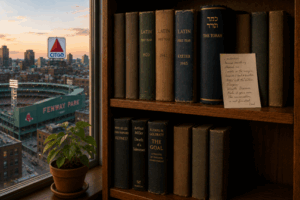

The boxes were already stacked by the door when I arrived. Caroline and her husband Quincy were packing their Boston apartment for the move to New York, where she will begin her medical residency. I carried boxes down to the truck. On one of the trips back up, I stopped at her bookshelf.
Three books on that shelf had come from me. The Goal. Who Killed John Maynard Keynes? and Death of a Salesman. Three different books across different disciplines, each asking different questions.
John Maynard Keynes spent his life asking how societies prosper. Arthur Miller asked why one man could still feel like a failure inside a prosperous society. Eliyahu Goldratt asked how an entire community moves forward together.
It was The Goal that brought me back to a question I have been carrying since 1991.
* * *
Why did the journey from Egypt to the Promised Land take forty years?
The geographical distance from the Sea of Reeds to the Jordan River is about two weeks of walking. Even with detours, caution, and the slow pace of an enormous encampment, the journey should not have taken anything close to forty years. Yet Bamidbar tells us that it did.
The traditional answer is punishment. The wilderness generation had sinned with the golden calf and again with the spies who brought back the bad report on the Promised Land. God decreed that the generation would die out in the desert before the next generation could enter. Forty years was the time required for that decree to be fulfilled.
That answer is in the text. But it has never been the whole answer for me. The book on Caroline’s shelf reminded me of a different one, an answer that arrived, oddly, through a novel about a manufacturing plant.
* * *
In 1991, in my second year at Harvard Business School, I read The Goal by the Israeli physicist Eliyahu Goldratt. The book is written as a novel about a plant manager whose factory is failing. Most of The Goal is about factories, bottlenecks, and throughput. But the scene that stayed with me for thirty-five years was not in the factory.
It was a Boy Scout hike.
Alex Rogo is leading his son’s troop through the woods. The boys spread out as they walk. The fastest race ahead. The slowest, a heavyset boy named Herbie, falls behind. The gap stretches. The line breaks. Alex tries to speed Herbie up. It does not work. He tries to slow the front boys down. It does not work.
Finally Alex realizes the simple, devastating truth. The pace of the entire group is not determined by the fastest. It is determined by the slowest. The solution is not to make the strongest stronger. The solution is to move Herbie to the front of the line and pace the troop to him. He redistribute the weight in his pack across the other boys and refuse to leave him behind.
That single insight is the foundation of what Goldratt called the Theory of Constraints. The throughput of any system is determined by its tightest constraint. Optimize the constraint and the whole system rises. Ignore the constraint and the whole system fails.
* * *
Goldratt thought he was teaching a lesson about manufacturing. I have come to believe he was teaching a lesson about Bamidbar.
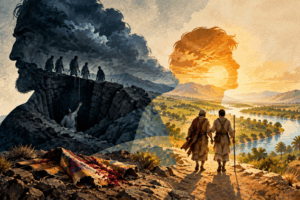
The wilderness was not merely punishment. The wilderness was pace.
God did not move the people at the speed of the fastest soul. God did not move them at the speed of the average soul. I began to wonder whether forty years was the time required for no one to be left behind.
The pillar of cloud did not disappear over the horizon and wait for Israel to catch up. When it rested, the people rested. When it moved, the people moved. Perhaps the wilderness was not simply a delay. Perhaps it was a discipline: God refusing to abandon the slowest soul at the back of the line.
* * *
In a theory, the slowest is a problem to be solved. In a theology, the slowest is a soul to be carried.
Goldratt called it the Theory of Constraints. I think the Torah reveals a Theology of Constraints.
* * *
With the last box carried down and the moving truck waiting in the street, I picked up her copy of The Goal. Caroline was about to begin medical residency, where questions of constraint would no longer belong to a business school classroom.
I did not yet know whose burden she would carry. I only knew she would know where to look.
I placed the book back on her shelf.
* * *
This evening I spoke with Caroline as she was finishing an overnight shift in the emergency room. We talked about how the floor organizes itself around competing needs: which patients cannot wait, which can, and where limited resources have to go first.
I asked if she remembered The Goal.
She did.
I suggested it might be time to read it again.
She smiled.
* * *
Boxes by the door.
On her shelf, the book I read.
The hike continues.
A companion essay: On Her Shelf
Starting Last and On Her Shelf are companion essays. Both open with the same scene — Caroline’s Boston apartment, boxes by the door, a bookshelf. Both close with the same haiku, but they pursue different questions.
Read together, the two essays describe the same covenant from two directions: vertical, from generation to generation, and horizontal, moving at the speed of the slowest soul in the line.
Torah, Midrash, and Further Study
A few of the Torah passages and Jewish sources behind this essay, for anyone who would like to read further.
Bamidbar (Numbers). The fourth book of the Torah, whose Hebrew name means “in the wilderness.” The book records the forty-year journey of Israel through the desert between Egypt and the Promised Land.
Bamidbar (Numbers) 14:33 to 34. God’s decree that Israel would wander for forty years in the wilderness, one year for each of the forty days the spies explored the land. The wilderness generation would not enter Canaan; only their children would.
Shemot (Exodus) 13:21 to 22; Bamidbar (Numbers) 9:15 to 23. The pillar of cloud by day and the pillar of fire by night that guided Israel through the wilderness. When the cloud rested, the people camped. When it lifted, the people traveled. The cloud set the pace of the entire journey.
Eliyahu Goldratt, The Goal (North River Press, 1984). A novel about a failing manufacturing plant whose central insight — the Theory of Constraints — holds that the throughput of any system is determined by its tightest constraint. The Herbie scene, in which a Boy Scout troop learns to pace itself to its slowest member, is the essay’s central parable.
The Chiddush
The wilderness was not merely punishment. The wilderness was pace. Perhaps forty years can also be understood as the time required for no one to be left behind. In a theory, the slowest is a problem to be solved. In a theology, the slowest is a soul to be carried.