“You are a blessing.”
The email came from someone very important in my life, after years of being at odds. I wrote back with forgiveness.
“My greatest wish has come true,” came the answer.
Nothing about the facts changed. Only what they were still allowed to decide.
* * *
I had spent that spring counting The Forty-nine days of the Omer, one at a time, the way you count towards something. Such counting works on you as it goes, a week on kindness, a week on restraint, a week on humility, until you are taking inventory of what you still choose to carry. The sixth week is yesod, foundation, and the forty-first day takes up tikkun, repair: the relationship allowed to cool, the apology owed, the rift left unattended, and what one small step might close it. I send those out each morning, and they had been arriving in this person’s inbox too. We had been counting the same days without knowing where the count was going.
* * *
Three days later, on Shabbat morning, the Torah began a count of its own. Bamidbar, tribe by tribe, family by family, the first wilderness census, a total of 603,550. I have written before about what that first count came to mean to me, that a people becomes a people by making sure everyone is counted.
What I wondered about that spring was what happened to those people after the counting.
Seven weeks later came another Shabbat, the Fourth of July, the United States’ two hundred and fiftieth. The portion was Pinchas, and in it the Torah counted again.
It is read as it was written, the same formula returning with a different name inside it, until the ear hears only the shape of the sentence. Thirty-eight years after the first census, after rebellion and plague and a generation of funerals, the total came to 601,730. A difference of 1,820. Set the totals side by side and almost nothing had happened; this couldn’t be further from the truth. Nearly every man counted the first time was gone. The number held because the people underneath it had been replaced.
Then the Torah broke its own pattern.
Not one of them was left except Caleb son of Jephunneh and Joshua son of Nun.
Of the 603,550, only two names appear in both lists. Why these two?
The Torah offers its own answer. Joshua and Caleb were the two spies who refused to join the other ten in bringing back a bad report about the Promised Land. Caleb is credited with a different spirit, one that followed wholly. Kalev has traditionally been heard as kol lev, whole heart; Yehoshua holds the root of yeshuah, salvation.
There is also the matter of where they came from. Joshua came from Ephraim, the tribe descended from Joseph, and Caleb from Judah. Those two brothers had once come close to destroying the family of Jacob.
* * *
The rabbis call it lashon hara, the evil tongue. The Torah’s own word for it is dibbah, a damaging word handed from one person to the next until it becomes what everyone knows and nobody has checked. Ten spies came back from the Promised Land carrying a dibbah. The word appears in one other place in the Torah and I had somehow never noticed where.
It is the second verse of the story of Joseph. Joseph is seventeen, shepherding with his brothers, and brings their father dibbatam ra’ah, a bad report about them. What he said the Torah never tells us and what follows is familiar: the colorful coat, the hatred, the brothers throwing him into an empty pit, one down inside and the others above. Judah sees the caravan bound for Egypt and proposes selling him rather than killing him. Twenty pieces of silver, Joseph goes down, the famine comes, and the family follows.
One bad word about a brother is what carried the family down.
* * *
Now standing at the edge of the Promised Land the word is heard again. Spoken then about a brother, Now it is spoken about a promise. Ten men repeat it and Joshua and Caleb refuse it, and all twelve had the same history behind them.
The word that carried the family down into Egypt is the word that kept a generation from ever entering the Promised Land.
* * *
In 2008 our family was in Costa Rica over Chanukah with the traveling menorah I always pack. On the first night another family at dinner saw the candles and asked to join us. By the end of the week we were friends. They were from Pikeville, Kentucky, the seat of Pike County, which is McCoy country and where the Hatfields were eventually tried. Somewhere in the conversation the feud came up. I thought the feud was distant history. Our new friends remembered it differently. The violence had ended long ago, but the feud was still inside lived in their memories.
The two families lived on opposite banks of the Tug Fork of the Big Sandy River, one in West Virginia and one in Kentucky. By 1888 at least a dozen were dead. Nobody agrees on what started it, whether the Civil War, a quarrel over timber, or a stolen pig. The men doing the killing had not begun the quarrel. They had been handed it.
The shooting stopped in 1891. The families shook hands in 1976. In June of 2003, more than sixty descendants gathered in that town and signed a truce declaring the hostilities over, now and forevermore. Reo Hatfield had drafted it with Bo McCoy after watching the towers come down. He was not saying a man never has to fight, only that he does not have to fight forever.
Not one of them had started the feud. They were simply the ones still alive who could finish it. A hundred and twelve years after the last shot, a handshake in between, and still they wrote it down.
* * *
Heraclitus wrote that no man steps into the same river twice, because it is not the same river and he is not the same man. Judah discovered something similar. Rabbi Jonathan Sacks, of blessed memory, called him the Torah’s first ba’al teshuvah, the first to show that an old moral test can be met by a changed man. It begins with Tamar, when Judah is shown evidence of his own wrongdoing and says that she is more righteous than he is.
Years later the test returns. Judah had once proposed selling Joseph, the favored son of Rachel, into slavery. Now he stands in front of Joseph in an Egyptian palace while Benjamin, Rachel’s other son, is about to be taken, and this time offers to stay in the boy’s place. Joseph reveals himself in the next breath, and the work of repairing the family begins.
It does not finish there. After Jacob dies the brothers come back, still afraid that Joseph may seek revenge. Some things take longer than a lifetime.
* * *
Which brings us back to Joshua and Caleb, a descendant of Joseph and a descendant of Judah, standing where ten other men repeated an old word and these two did not.
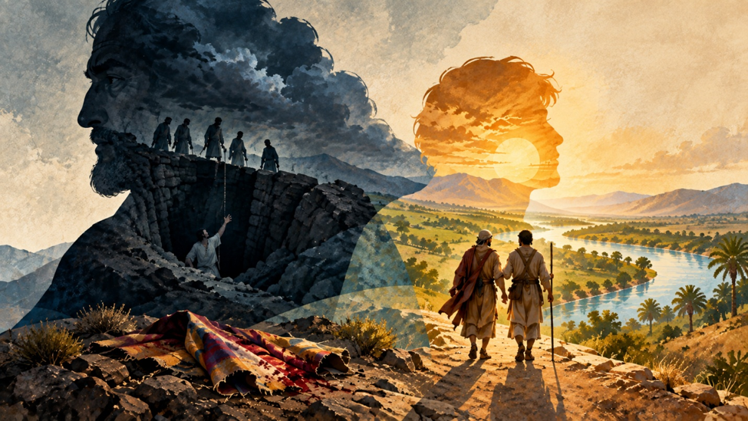
Their ancestors had stood at a dry pit, one down inside it and one at the rim. Their descendants stood together at a river.
Forty years is a long while to cross two weeks of desert. It is not long at all to carry a family from the pit to the river.
* * *
There is one more thing in Pinchas. The portion does not merely record that Joshua survived. Later in the same reading God tells Moses to bring him before the community, lay a hand upon him, and give him the future. The descendant of Joseph who refused the old word leads the next generation across.
* * *
That spring I had counted to forty-nine and somewhere inside that count two people long at odds asked one another for forgiveness. Three days later the Torah counted 603,550, and seven weeks later 601,730. Almost the same number. Almost entirely different people.
In the middle of the arithmetic, the Torah stopped counting and gave two names.
Caleb. Joshua.
A son of Judah.
And a son of Joseph.
Nothing about the facts had changed. Only what they were still allowed to decide.
* * *
* * *
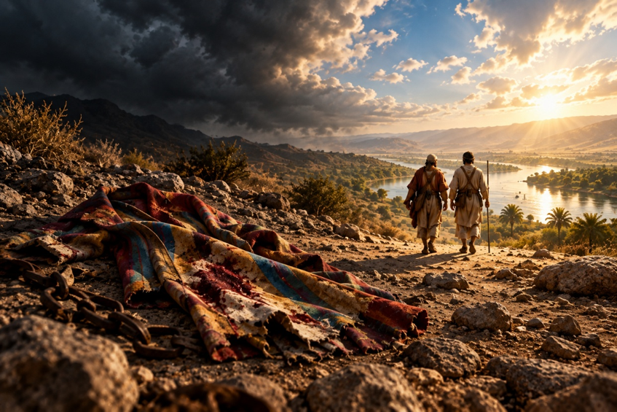
Dry pit, long ago.
Their heirs stand at the Jordan.
Side by side, they cross.
* * *
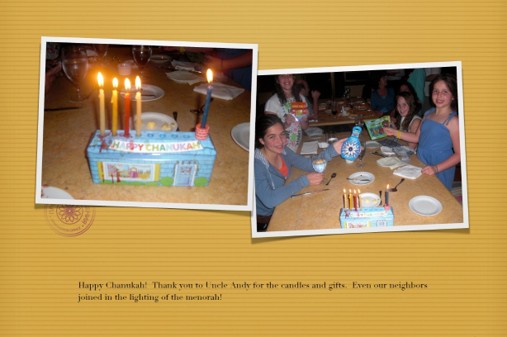
Chanukah 2008, Costa Rica. Caroline, Lucy, Olivia and Gabrielle lighting the traveling menorah with our new friends from Pikeville, Kentucky, who saw our Menorah Candles at dinner on the first night and asked if they could join us.
Torah, Midrash, and Further Study
A few of the Torah passages and Jewish sources behind this essay, for anyone who would like to read further.
Bereshit (Genesis) 37:2. Joseph, seventeen years old, brings his father dibbatam ra’ah, a bad report about his brothers. Apart from the spy episode, this is the only other appearance of dibbah in the Torah.
Bereshit (Genesis) 37:23 to 28. The brothers strip Joseph of his coat and cast him into the pit, which the verse twice notes held nothing. Judah proposes selling him to the passing Ishmaelites for twenty pieces of silver.
Bereshit (Genesis) 38:25 to 26. Shown his own staff, seal, and cord, Judah says that Tamar is more righteous than he is. Rabbi Sacks reads this as the first admission of wrongdoing in scripture and the beginning of Judah’s teshuvah.
Bereshit (Genesis) 44:18 to 34. Judah offers himself in place of Benjamin so that Benjamin may return to their father. Joseph reveals himself immediately afterward.
Bamidbar (Numbers) 13 to 14. The twelve spies. Ten bring back the dibbah about the Promised Land, and Numbers 14:24 credits Caleb with a different spirit, one that followed wholly.
Bamidbar (Numbers) 1 and 26. The two wilderness censuses, in Parashat Bamidbar and Parashat Pinchas, counting 603,550 men of military age and then 601,730. At 26:64 the accounting breaks: not one of those counted in the wilderness of Sinai was left except Caleb son of Jephunneh and Joshua son of Nun.
Rabbi Jonathan Sacks, Covenant and Conversation. The reading of Judah as the Torah’s first ba’al teshuvah, the first figure who meets the same test twice and answers it differently.
Rabbi David Fohrman, Aleph Beta. The close reading that links the dibbah of the spies to Joseph’s dibbah about his brothers.
Breaking Matzo, Counting the Omer, Day 41: Repair. (May 13, 2026)
The concept of tikkun, repair, sits close to Yesod. Repair begins close in: the relationship you let cool, the apology you owe, the rift you’ve been avoiding. You cannot repair the world until you are willing to repair what is within your reach.
What is one relationship in need of repair and what is one small step you could take toward it?
Heraclitus, fragments, roughly 500 BCE. The Greek philosopher who held that a man cannot step into the same river twice, because neither the river nor the man is the same.
The Hatfield and McCoy truce, Pikeville, Kentucky, June 14, 2003. More than sixty descendants signed a truce formally ending hostilities that had claimed at least a dozen lives. The fighting had stopped in 1891 and the families had shaken hands in 1976.
Chiddush: Of the 603,550 counted at the start, only two names survive into the second census: a descendant of Joseph and a descendant of Judah, the tribes descended from the brothers whose fracture sent the family down to Egypt. Joshua and Caleb inherited both that fracture and the repair that followed it, and when the old word returned at the edge of the Promised Land, ten men repeated it and these two did not, though all twelve had the same history behind them. The second census records not who survived the wilderness, but what survived it: repair.
We cannot choose what we inherit. We can choose what becomes an inheritance.