

One breath on all things,
one flame bows, one sail rises.
What wind am I now?
* * *
May 27, 2026, 8:31 AM. To Quincy:
I am so so proud of your resilience and determination and passion to be graduated from Harvard Law School. Each step of your journey revealed new dimensions of your character that have impressed me in many ways. Mazel Tov! Enjoy today and tomorrow and take it all in!
Quincy:
Thank you!!!!!!! I could not be more happy and grateful!!!! Caroline and I are just beaming and I feel so lucky to have been able to join this big Harvard family!! Thank you for leading the charge for us and for the LSAT materials!! I can’t wait to celebrate 🎉
Me:
You are welcome! In every way. However, I have not been your leader. I have been your cheerleader! The Midrash teaches that every blade of grass has an angel flying over it saying “grow, grow, grow.” I would add that every sailboat has those behind it that “blow, blow, blow.” 💨💨💨❤️❤️❤️
* * *
I sent the first of those texts to Quincy at 8:31 on the morning of his Harvard Law School graduation. I almost didn’t send the second.
Quincy is my daughter Caroline’s husband. He has been part of our family for eleven years. Five years ago, when he was applying to law school, I offered what advice I could. Four years ago, when he was preparing for the LSAT, I sent him books and resources I could find. I was not his tutor nor his teacher, I was his cheerleader.
A cheerleader has no authority. Encouragement may be the purest form of influence, because it asks for nothing except another person’s flourishing.
In the second text, almost without planning to, I quoted a line I have always loved: a teaching from the Midrash, from Bereshit Rabbah, that there is not a single blade of grass below that does not have an angel above it, whispering “Grow, grow, grow”. I added something entirely new this time: that every sailboat has, behind it, those who “blow, blow, blow.”
I pressed the heart, pressed the three small winds, hit send, and put the phone down. Only later, on a long walk, did I realize I had written more theology into a text message than I usually manage in an essay. Because those three little words, “blow, blow, blow,” turned out to answer one of the oldest questions in Judaism. What is the difference between the wind that snuffs the candle and the wind that fills the sail?
It reminded me of a song. In 1973, Elton John sang Candle in the Wind, a tribute to Marilyn Monroe, who had died eleven years earlier at thirty-six. The song imagines her as a candle burning beautifully against the dark, its flame always one breath from being put out by the cruelty of fame. I have always loved that song. Only recently did I understand why. The song is about a candle, but it is really about wind.
There is a phrase in the second verse of Genesis. In the beginning the earth was tohu va’vohu, wild and empty. Darkness lay over the face of the deep and ruach Elohim moved over the face of the waters. The breath of God. The wind of God. The spirit of God.
Ruach does extraordinary work in that verse. It means three things at once: breath, wind, spirit. English splits them into separate words; Hebrew keeps them as one. When God made the world, he did not begin with light., he began with breath. Before there was anything to see, there was something to feel.
A candle and a sailboat receive exactly the same wind: the same moving air, the same molecules. To the candle, that wind is a threat: it guts the flame, it ends the story. To the sailboat, that same wind is propulsion: it fills the canvas, it carries the journey home.
The difference is not in the air, it is in the surface that meets the air. The wind is ruach, and ruach is neither kind nor cruel. It is the same breath either way. Which means the question is never what the wind is. The question is always what stands in it.
The Torah knows both winds and puts them in the same place.
In Deuteronomy, Moses makes the people remember Amalek. As the freed Hebrew slaves walked out of Egypt into the wilderness, Amalek attacked, and the Torah is precise about how. Amalek did not meet Israel head-on, butcame at the rear of the column and struck the stragglers. Amalek is the wind that picks off the candles at the back of the line.
Then there is the other wind, standing in exactly the same spot.
I once wrote about Bamidbar, the wilderness census, and Joshua and Caleb, the only two counted in the first generation who lived to be counted in the second. Joshua and Caleb lived out the meanings the tradition has long associated with their names: Joshua, salvation; Caleb, a whole heart. One came from Joseph’s line and one from Judah’s, the two brothers who finally reconciled. They were the only spies who refused to bring dibbah, a bad report, on the Promised Land. When the people were ready to let their flame dim, Joshua and Caleb blew on it.
Amalek went to the back of the line to pick off the slowest. Joshua and Caleb went to the back of the line to carry the slowest forward.
This is the choice every parent, coach, teacher, and friend makes, often without even noticing. We can be Amalek or we can be Joshua. We can stand behind a person’s life and pick at the flickering flame or stand behind it and whisper grow.
I have a candle in my house that proves it can be done. Joan and I keep a menorah that once belonged to Marilyn Monroe, the very candle of that song, and a woman Joan has loved since girlhood. Marilyn converted to Judaism before her marriage to Arthur Miller in 1956 and lit Hanukkah candles in her own home. By some improbable grace, her menorah now sits on our table. Joan and I lit it together on our first shared Hanukkah. Since then, Caroline, Lucy, Quincy, Avi, and Julie have all gathered around that same light. When you light it, it plays Hatikvah, the Hope. The wind tried to snuff Marilyn’s candle, but her menorah is still burning, every Hanukkah, in a Jewish home in Miami, still playing the song of hope.
Five years ago, I gave Quincy advice on his law school applications. Four years ago, I gave him LSAT books. This year, I send him wind.
When I texted Quincy that morning, I did not know I was writing a midrash. I was just sending a few words to my son-in-law, on a morning that was his and not mine. But I think I was trying to do the one thing a cheerleader can do: to stand at the back of his line and be the kind of wind that carries rather than the kind that snuffs.
Joan and I pray that our children, Caroline, Lucy, Avi, Julie, and now Quincy, will always recognize the breath of God that can fill a sail. We pray that they, in their turn, will become that same breath for someone else.
Perhaps that is what the angels over every blade of grass have been whispering all along. The wind has always been there. The wind always will be. The only thing we ever decide is what kind of wind we become.
* * *
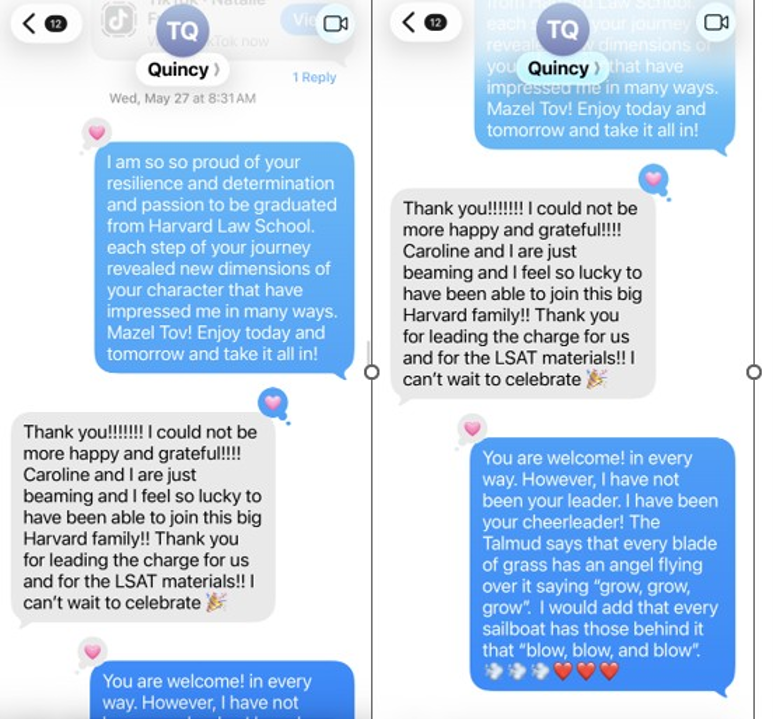
Texts from Quincy’s graduation morning. May 2026.
(I called it Talmud but it was actually Midrash)
* * *
Torah, Midrash, and Further Study
A few of the Torah passages and Jewish sources behind this essay, for anyone who would like to read further.
Bereshit (Genesis) 1:2. Ruach Elohim, the breath, wind, and spirit of God moving over the waters. One word, ruach, holds all three.
Bereshit Rabbah 10:6. The teaching that every blade of grass has an angel above it, whispering “grow, grow, grow.”
Shemot (Exodus) 17:8 to 16. Amalek attacks Israel in the wilderness, the first battle after the Exodus.
Devarim (Deuteronomy) 25:17 to 19. “Remember what Amalek did… how he struck those lagging behind.” Amalek comes at the back of the line.
Bamidbar (Numbers) 13 to 14. Joshua and Caleb alone bring back a hopeful report, refusing the dibbah, the bad report, of the other spies.
Bamidbar (Numbers) 26. The second census. Joshua and Caleb are the only two of their generation counted again.
Hatikvah, “The Hope.” The Israeli national anthem, played by Marilyn Monroe’s menorah.