
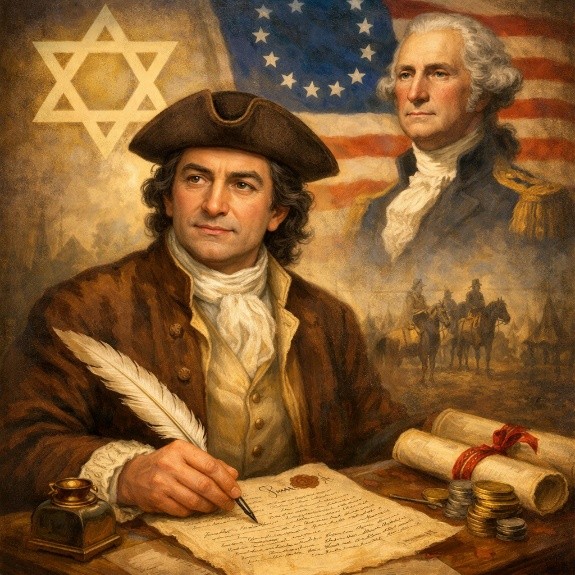
In the same spirit of elastic faith that allows a people to adapt, endure, and act beyond immediate self-interest, one of the American Revolution’s most extraordinary and overlooked contributors was a Jewish immigrant named Haym Salomon. His story reminds us that nations are built not only by generals and statesmen, but by quiet figures willing to face uncertainty for a future they may never see.
Haym Salomon arrived in the American colonies without title, inheritance, or privilege. Born in Leszno, Poland in 1740, into a life shaped by Jewish displacement and uncertainty, he learned languages, finance, and trade in Europe before crossing the Atlantic just as the colonies moved toward revolution.
He arrived in New York in 1775, on the eve of war and quickly aligned himself with the Patriot cause. He joined the Sons of Liberty as tensions erupted into open conflict. His linguistic abilities and financial skills distinguished him immediately. While imprisoned by British forces for alleged espionage, Salomon served as an interpreter and, at great personal risk, covertly persuaded Hessian mercenaries to abandon British service—transforming captivity into resistance.
It was Salomon’s role as a financier that elevated him into true historical consequence. As colonial currency collapsed and credit vanished, the Patriot cause teetered on the brink of failure. Working closely with Robert Morris, Superintendent of Finance for the Continental Congress, Salomon brokered loans, endorsed notes, and extended personal credit when traditional sources of funding collapsed. His efforts provided the critical liquidity that kept Washington’s army in the field through its most desperate moments.
Salomon repeatedly placed himself in financial, political, and physical danger to keep the revolution alive. Many of those sacrifices were never repaid and his contributions remained largely invisible to the public record. The young United States, deeply indebted and financially strained, failed to fully honor many of the advances and guarantees he extended.
He died in Philadelphia in 1785, worn down by illness and financial loss. By some estimates, the funds he advanced would be worth tens of millions of dollars today.
Rarely mentioned alongside Washington, Jefferson, or Adams, Haym Salomon nevertheless exemplifies what it means to stretch beyond ordinary limits in pursuit of freedom and faith. His courage, financial ingenuity, and willingness to sacrifice everything for a cause greater than himself connect deeply to the shared spiritual DNA of the Jewish people and the American experiment.
History often celebrates its visible heroes. Faith remembers its bridges.
Haym Salomon’s life reminds us that elastic faith is not measured by what we inherit, but by what we are willing to give for a future we may never see.
A Torah Reflection on Haym Salomon
The Torah repeatedly reminds us that the most consequential builders of history are not always its beneficiaries. Moses leads the Israelites through the wilderness yet never enters the Promised Land; his greatness lies not in arrival, but in fidelity to purpose. As Pirkei Avot teaches: “It is not upon you to finish the work, nor are you free to withdraw from it.”
Haym Salomon stands firmly in this tradition. A Jewish immigrant who helped finance the American Revolution at extraordinary personal risk—and profound personal cost—he embodied emunah not as faith in reward, but as faith in responsibility. He acted on behalf of a future he would not live to enjoy, sustaining a fragile experiment in liberty when its survival was far from assured.
In Torah terms, this is covenantal faith: the willingness to serve a cause larger than oneself, without assurance of recognition or return. Salomon’s life reminds us that righteousness is not measured by outcomes we control, but by commitments we honor, especially when history demands sacrifice without applause.
For a broader reflection on how this kind of sacrifice fits within the shared spiritual DNA of America and Israel, see Elastic Faith: The Shared Soul of Israel and the United States.