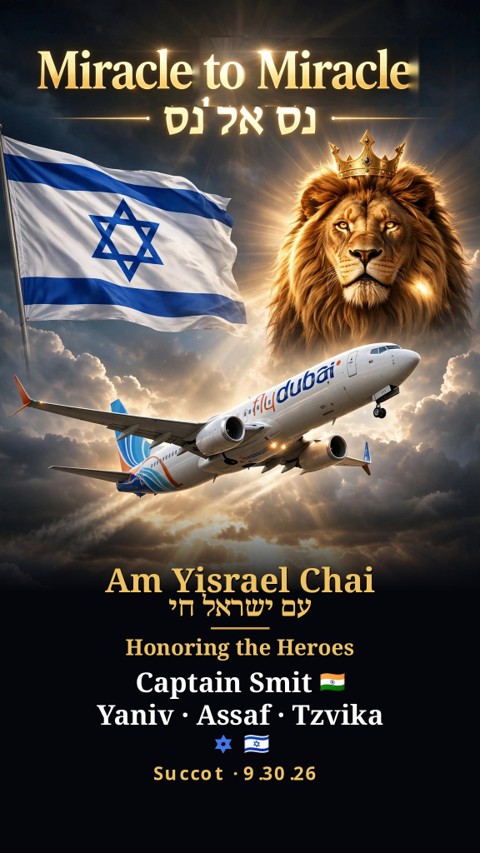
On Wednesday, September 30, the fifth day of Sukkot, 174 people boarded flydubai Flight FZ1073 from Dubai to Tel Aviv, 166 of them Israelis. Somewhere over the desert the co-pilot turned on Captain Smit Machchhar and viciously stabbed him, and the aircraft began to fall, from about 33,000 feet toward 17,000. Gravely wounded, with the plane dropping beneath him, Captain Smit did the one thing still within his reach. He released the cockpit door.
Yaniv Hayun went through it, helped overpower the co-pilot terrorist, and took hold of the controls as the plane descended. Assaf Rajwan and Tzvika Manes fought the terrorist down beside him, Tzvika having moved his young daughter away from the front of the cabin before he moved toward the danger. Dr. Shota Musayev, a dentist, stopped the bleeding. Two off-duty pilots who happened to be aboard steadied the aircraft and, with the crew, brought it down in Tabuk, Saudi Arabia, a country with no current diplomatic relations with Israel, where soldiers, nurses, and doctors met a planeload of frightened Israelis with reassurance and care. Everyone survived.
* * *
Lital Shahar, traveling with her four daughters, said afterward that she had witnessed two miracles: the passengers who went into the cockpit, and the pilots who were aboard to bring them to the ground. Two miracles, the first handing the passengers to the second. In Hebrew I hear it as nes el nes, נס אל נס, miracle to miracle, the way the Torah says Moses spoke with God panim el panim, face to face. The word nes means miracle, but in the Torah it is a banner, a pole raised high so the whole camp can see it. When serpents struck the Israelites in the wilderness, Moses was told to set a copper serpent al nes, upon a pole, and whoever looked up at it lived. A nes is not only something that happens to people. It is something lifted where others can see it.
And all of it happened on Sukkot. The Torah commands us to dwell in booths for seven days so that our generations will know that God made the Children of Israel dwell in sukkot when He brought them out of Egypt. The Talmud records a disagreement over what those sukkot were. Rabbi Eliezer says they were the ananei hakavod, the clouds of glory, heaven itself wrapped around the camp. Rabbi Akiva says they were sukkot mamash, real booths, built by the people with their own hands. The practice we inherited keeps both. We remember the clouds by building, every year, a hut with our hands. Sukkah and schach, its leafy roof, share a root that means to cover or shelter, the same root the psalmist uses when he promises that God will cover you with His wing. The law asks that the schach give more shade than sun, and tradition asks that the stars still show through.
The passengers of FZ1073 sat inside one of the most carefully engineered shelters human beings know how to build, and for a stretch of sky it could not protect them. What covered them came through a door that a wounded man opened: a captain from India, a dentist, two pilots who had been passengers that morning, three Israeli men who had not boarded together and had never trained for anything like this, and, on the ground in Tabuk, Saudi doctors, nurses, and soldiers who took their blood pressure, brought them food, and kept telling them they were in a safe place now. Assaf Rajwan said afterward, “Life is stronger than everything, and we decided to fight for it,” and he would not let the rescue be called his alone.
So let these names go up on the pole: Captain Smit Machchhar, Yaniv Hayun, Assaf Rajwan, Tzvika Manes, Dr. Shota Musayev, two pilots who were passengers until they were needed, and the people of Tabuk whose names we may never learn.
* * *
This week we sit beneath schach and look up through it at the stars. Rabbi Eliezer and Rabbi Akiva are still arguing about what covered our ancestors in the desert. Ask the 174 people who crossed a desert sky on the fifth day of Sukkot, and they will give you both answers at once.
Chag Sameach. Am Yisrael Chai.
Torah, Midrash, and Further Study
A few of the Torah passages and Jewish sources behind this essay, for anyone who would like to read further.
From the Breaking Matzo archive: Flying Fueled with Faith: Connections Between Abraham, Amsterdam, El Al, and Dubai (November 2024). Written after the November 2024 attacks on Maccabi Tel Aviv fans in Amsterdam, when El Al flew them home on Shabbat. It reads the rescue through Abraham and closes on the Abraham Accords and flydubai, which kept flying to Israel when others stopped. Two years later, a flydubai flight became this essay. Read it here.
Vayikra (Leviticus) 23:42 to 43. The command to dwell in sukkot for seven days, so that later generations will know that God made the Children of Israel dwell in sukkot when He brought them out of Egypt.
Talmud Bavli, Sukkah 11b. Rabbi Eliezer says the sukkot of the wilderness were the clouds of glory; Rabbi Akiva says they were real booths that the people built.
Mishnah Sukkah 1:1; Shulchan Aruch, Orach Chaim 631:3. A sukkah whose sun exceeds its shade is not valid, and the schach is ideally thin enough that the larger stars can be seen through it.
Tehillim (Psalms) 91:4. With His pinions He will cover you, and under His wings you will find refuge. The verb, yasekh, comes from the same root as sukkah and schach.
Bamidbar (Numbers) 21:8 to 9. Moses sets the copper serpent upon a pole, al nes, and whoever looks at it lives. Nes as a banner raised where everyone can see it.
Shemot (Exodus) 33:11. God speaks to Moses panim el panim, face to face, as a person speaks to a friend. The same construction as nes el nes, miracle to miracle.
Shemot (Exodus) 17:15. After the battle with Amalek, Moses builds an altar and names it Adonai Nissi, God is my banner.