A friend is not simply someone who stands beside you when things are going well. A friend sees not only who you are, but who you may become.
That kind of friendship is rare between people. Between nations, it is almost unheard of. Two hundred and fifty years ago, one nation looked west across the Atlantic at an unfinished republic and said: I see what this will be. It did not wait for proof or victory, it simply opened the door.
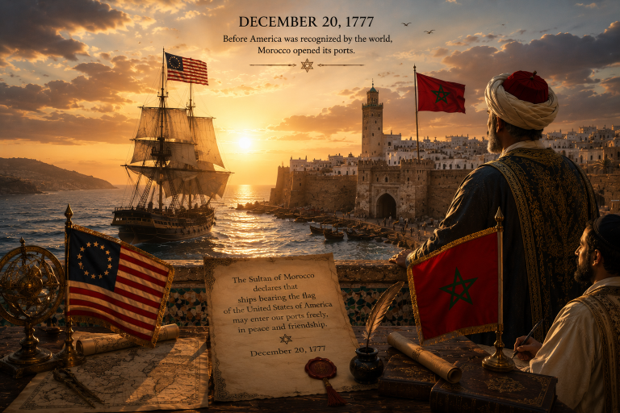
That nation was Morocco. The friendship it extended in 1777 remains the longest unbroken diplomatic relationship in American history.
On December 19, 1777, George Washington led what remained of his army into winter quarters at Valley Forge. The ground was frozen and his men had no shoes. The outcome of the Revolution was not a question of strategy that night. It was a question of survival.
One day later, Sultan Mohammed III of Morocco issued a decree. Any vessel sailing under the American flag could enter Moroccan ports freely, without tribute and without threat. No other nation had done this. France would follow six weeks later. Britain’s other colonies would not. Morocco named the struggling republic as a friend.
To understand why Morocco could see what others could not, you have to understand where Morocco stands. Morocco has always lived at a threshold. Where the Atlantic enters the Mediterranean. Where Africa reaches toward Europe. Where Arab, Amazigh, Jewish, African, and European civilizations have met for centuries. Kingdoms built at such a crossroads learn that bridges are more valuable than walls.
Sultan Mohammed III understood this lesson well. He built Essaouira on Morocco’s Atlantic coast as a deliberate international city. Muslim and Jewish merchants shared its markets. European engineers raised its walls. Goods from the Sahara, the Caribbean, and the Mediterranean moved through its warehouses. Multiple languages rang in a single transaction. Essaouira was not a compromise between civilizations. It was what happens when a civilization decides that connection is a form of strength.
Sultan Mohammed III also trusted Jewish advisers to represent Morocco to the world. Among the sultan’s advisers was Samuel Sumbal, who served as his diplomatic agent and confidential secretary. Sumbal managed Morocoo’s relationships with the courts of Europe. He was also the nagid, the communal leader, of Morocco’s Jewish communities. He became a translator not only of language, but of civilization.
When America did not respond to the sultan’s opening gesture, he found a way to be heard. In 1784, Moroccan ships seized an American merchant vessel, the Betsey. The crew was taken to Tangier, unharmed, to be held until a treaty was concluded. It was a raised hand, not a clenched fist. The Americans finally sent an envoy and the Treaty of Peace and Friendship was signed in 1786, ratified by Congress in July 1787 — two months before the Constitution was signed.
* * *
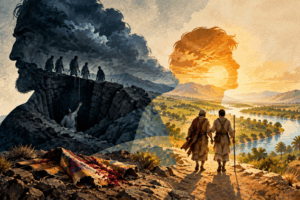
In Bereshit, God speaks to Abram before Abram has done anything to earn the name. Lech lecha: go forth. Not after you have proven yourself. I name what you will become. Recognition preceded reality. The name came before the nation.
This is what friendship does that diplomacy cannot. Diplomacy waits for facts. Friendship acts on what it believes the other can become.
* * *
Nearly two centuries later, another Moroccan king would again recognize what others refused to see. When Vichy France demanded that Sultan Mohammed V hand over Morocco’s Jews, he refused. Vichy France saw Jews. Mohammed V saw Moroccans. He reportedly told French officials: there are no Jews in Morocco, only Moroccan subjects. Of Morocco’s 250,000 Jews, none were deported and none wore the yellow star. The same instinct, two centuries apart: see the full humanity of the person in front of you before the world has finished deciding what that person is worth.
Those Moroccan Jews carried their world with them when they left. Moses Elias Levy, born in Mogador on Morocco’s Atlantic coast, came to Florida dreaming of a refuge for persecuted Jews. In 1845, his son David became the first Jewish member of the United States Senate, eventually adding his Moroccan ancestral name to his own: David Levy Yulee. A county in Florida still bears his family’s name.
The nation that first recognized America had long recognized its Jews as part of itself. That recognition, too, had a long reach.
* * *
History remembers the victories. Faith remembers the first friend.
When two seas meet at Cape Spartel, Morocco’s northwestern tip, they do not erase one another. The Atlantic and the Mediterranean become something neither was alone. Morocco has watched this every day for centuries. Perhaps that is why it understood, before almost anyone else, that a new nation across the ocean was not a threat to the existing order, but an addition to it.
Before there was certainty, there was belief. Before there was victory, there was friendship. Before America found her place among the nations, one kingdom on Africa’s Atlantic shore looked west and made room for her.
Torah, Midrash, and Further Study
A few of the Torah passages and Jewish sources behind this essay, for anyone who would like to read further.
Bereshit (Genesis) 12:1 to 3. Lech lecha — go forth. God speaks to Abram before Abram has done anything to earn the covenant. The call precedes the person. Recognition does not wait for proof; it names what will become true.
Bereshit (Genesis) 17:5. God changes Abram’s name to Abraham — father of many nations — before a single nation has come into being. The rabbis note that to name something fully is to help bring it into existence.
The Moroccan-American Treaty of Peace and Friendship, 1786. Signed in Marrakesh by Thomas Barclay and Sultan Mohammed III, countersigned by John Adams and Thomas Jefferson, ratified by Congress in July 1787 — two months before the United States Constitution was signed. It is the longest unbroken treaty relationship in American history. Morocco gifted the United States its first diplomatic building in Tangier in 1821; it remains the only United States National Historic Landmark located in another country.
Samuel Sumbal (d. 1782). Jewish merchant, diplomat, and confidential adviser to Sultan Mohammed III of Morocco. Educated in Marseille and fluent in European languages, he served as diplomatic agent of the Sharifian court and as nagid, communal leader, of Morocco’s Jewish communities. His role in shaping the sultan’s Atlantic diplomacy is documented by historian Daniel J. Schroeter.
Moses Elias Levy (1782 to 1854) and David Levy Yulee (1810 to 1886). Moses was born in Mogador, Morocco, and established himself in the Florida Territory, purchasing 50,000 acres with the intention of building a Jewish refuge he called Pilgrimage Plantation. His son David became in 1845 the first Jewish member of the United States Senate, representing Florida, later adding the Moroccan ancestral name Yulee to his own. Levy County, Florida, is named for this family.
Sultan Mohammed V of Morocco and the Jews of World War II. When Vichy France demanded that Mohammed V apply anti-Jewish laws across Morocco, he refused. He reportedly told French officials there were no Jews in Morocco, only Moroccan subjects. He retained Jewish officials in government, publicly invited Jewish leaders to sit beside him in a national ceremony, and resisted the imposition of the yellow star. Of Morocco’s approximately 250,000 Jews, none was deported to the Nazi death camps.
Breaking Matzo: Related Essays
History of Moroccan Jews: Fluctuation and Migration
Two thousand years of Moroccan Jewish life — from the Roman Empire through the founding of the mellahs, the Vichy years, and the great emigration — told through community voices and culinary tradition.
The Memorable Magic of Moroccan Cuisine
How the Shabbat table, the Mimouna, the henna feast, and the spice trade turned Moroccan Jewish cooking into one of the most layered and joyful cuisines in the world.
The Magic Carpet Was Never About Flying
A meditation on the Moroccan Jewish tradition of the flying carpet as a metaphor for exile and return — the carpet that carries you is the community that holds you.
Chiddush:
Recognition is an act of faith. Nations, like people, often become what someone first believes they can become. The essay is not really about diplomacy. It is about the spiritual meaning of being the first friend — the one who sees who you may yet become before you can
***
Share This Blog
If this blog spoke to you, please pass it along. Share the link or simply tell someone about it.
Share on social: @breakingmatzo (Instagram & Facebook)
Subscribe to Breaking Matzo
New to Breaking Matzo? Join 40,000 readers who receive each new essay in their inbox. Subscribe at: breakingmatzo.com
Questions or thoughts? Write to us: contact@breakingmatzo.com