
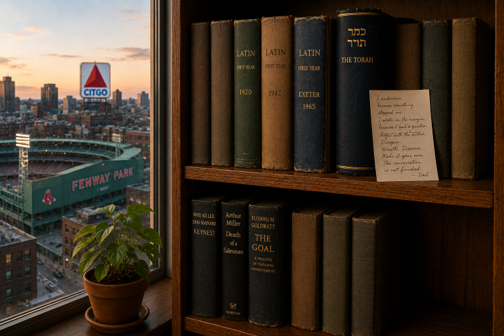
The boxes were already stacked by the door when I arrived. Caroline and her husband Quincy were packing up their Boston apartment to move to New York, where she will begin her medical residency. I carried boxes down to the moving truck. On one of the trips back up, I stopped at her bookshelf.
There is an old expression: Don’t judge a book by its cover. I have come to believe something different. A bookshelf is not decoration, but a biography. Every book on it is the result of a choice: which ones to buy, which ones to read, which ones to keep, and which ones to carry across a move. Over time, a bookshelf becomes a kind of self-portrait. It reveals what someone has been thinking about, what they hope to remember, and what new conversations they are still waiting to discover.
But a bookshelf is not only a self-portrait.
It is also a record of those who have loved you.
At their wedding, I gave Caroline and Quincy five books. Not new books. Books that had lived on shelves in my family across four generations. I wanted them to begin their marriage with pages that had already been turned by people who loved them, words that had already been underlined, margins that had already been written in.
The first was my grandfather Normy’s freshman Latin book from 1920, years before he attended Harvard Law School, where Quincy would soon earn his own law degree. Caroline carries his name as her middle name.
The second was my mother’s freshman Latin book from 1942. To Caroline and Lucy, she was simply Nana.
The third was my own first-year Latin text from Phillips Exeter Academy in 1985, the same school where, years later, Caroline and Quincy would meet.
The fourth was one of my mother’s favorite books, a reminder that every generation leaves behind something different: not only possessions, but the ideas that shaped a life.
The fifth book was different. It was a Torah, given to Quincy for his studies. The other four carried conversations that had shaped generations of my family. This one carried the conversation that had shaped them all.
* * *
Three books I had given Caroline over the years caught my eye. One was Who Killed John Maynard Keynes?, which had profoundly influenced how I thought about economics for thirty years. One was Arthur Miller’s Death of a Salesman, the story of Willy Loman. Arthur Miller later married Marilyn Monroe, a fact that took me, in ways I did not expect, to another Breaking Matzo essay. And the last was The Goal, by the Israeli physicist Eliyahu Goldratt, a novel about what happens when a community learns to move at the pace of its slowest member.
John Maynard Keynes spent his life asking how societies prosper and why, left to themselves, they sometimes fail entire nations. Arthur Miller asked why one man could still feel like a failure inside a prosperous society. Eliyahu Goldratt asked how an entire community moves forward together.
It took me thirty-five years to realize that those three books had been talking to one another all along. Each one showing something the others could not.
Years later, I found myself thinking about Good Will Hunting. During my years at Harvard, I had the opportunity to meet both Robin Williams and Matt Damon. Their film gave me language for something I had slowly been discovering myself. Looking back on those decades, I realized that my own journey had been similar. I once thought the challenge was reading more books. Over time I discovered the greater challenge was allowing those books to read me.
Standing in front of Caroline’s bookshelf, I realized something else. Those conversations had not ended with me. They had simply moved to another shelf.
* * *
Caroline and Quincy’s wedding fell on Parashat Va-Yeilech. The portion takes its name from its opening words: va-yeilech Moshe “and Moses went.” At the end of his life, Moses walked toward the people one final time. He entrusted the Torah to the next generation so the conversation would not end and commanded that it be read publicly every seven years, in the presence of everyone: men and women and children and the stranger within your gates.
The Torah was never meant to sit quietly on a shelf. It was meant to be read, questioned, remembered, argued over, and lived.
At their rehearsal dinner, I gave Caroline and Quincy the five books of my own. Not because I imagined they belonged beside Moses’ five books, but because I hoped they would serve the same purpose. To begin conversations that would become part of the home they would build together, grounded in faith, curiosity, and understanding.
* * *
In Devarim, in the passage we call the Shema, Moses had already said it: teach these words to your children. Speak with them when you sit in your house and when you walk by the way. The commandment is not merely to preserve the words. It is to keep the conversation alive.
Those books were no longer sitting quietly beside one another. Keynes, Miller, and Goldratt had joined a conversation Moses began generations earlier. Every bookshelf can become a Beit Midrash, a house of study where texts never stop speaking to one another. Every generation enters the conversation before it realizes the discussion has already begun.
Suddenly Caroline’s bookshelf looked different. It was no longer a collection. It had become a conversation.
Someday Caroline and Quincy will add their own voices.
* * *
A book on a shelf is a conversation waiting to resume. Every time Caroline opens one of those books, she is not reading alone. She is reading with everyone who read it before her: with Normy, with Nana, with me. The margins hold the argument. The underlines hold the surprise. The dog-eared pages hold the moment someone stopped.
We think we are passing books down. We are passing the experience of being stopped. You cannot hand someone the feeling that arrested you on page forty-seven. But you can hand them the book and the page will find them too.
Inside each of the five books I gave Caroline and Quincy rests a handwritten note. The notes are still there, traveling with the books, waiting quietly to be discovered.
One day Caroline will open one of those books. Or Quincy will. I do not know which one. I do not know when. I do not know what either of them will be carrying that day.
Some words have to wait until the reader has become the person who can finally hear them.
The note inside the book has been waiting all along.
So has the verse.
The truck was loaded. The apartment was nearly empty. I reached for a book. It no longer belonged to me. It had become hers.
She will think it was waiting for her.
It was.
I placed the book back on her shelf.

***
Boxes by the door.
On her shelf, the book I read.
The hike continues.
* * *
A companion essay: Starting Last
Starting Last and On Her Shelf are companion essays. Both open with the same scene — Caroline’s Boston apartment, boxes by the door, a bookshelf. Both close with the same haiku, but they pursue different questions.
Read together, the two essays describe the same covenant from two directions: vertical, from generation to generation, and horizontal, moving at the speed of the slowest soul in the line.
Torah, Midrash, and Further Study
A few of the Torah passages and Jewish sources behind this essay, for anyone who would like to read further.
Devarim (Deuteronomy) 31. Parashat Va-Yeilech. “And Moses went.” At the end of his life, Moses entrusted the Torah to the next generation and commanded that it be read publicly every seven years in the presence of everyone. The wedding of Caroline and Quincy fell on the Shabbat morning of this portion.
Devarim (Deuteronomy) 6:4 to 9. The Shema. The central declaration of Jewish faith and the commandment at the heart of this essay: teach these words to your children, speak them when you sit in your house and when you walk by the way. The commandment is not to preserve the words. It is to keep the conversation alive.
Devarim (Deuteronomy) 31:10 to 13. Hakhel. The commandment to gather the entire community every seven years for a public reading of Torah — men, women, children, and the stranger within the gates. No one inherits Torah alone.
Beit Midrash. The traditional Jewish house of study where texts are argued over in pairs, one voice answering another across generations. Every bookshelf chosen with care becomes a Beit Midrash.
Eliyahu Goldratt, The Goal (North River Press, 1984). The central insight — the pace of a system is determined by its slowest member — is paraphrased in the essay to show how communities move forward together.
Arthur Miller, Death of a Salesman (Viking Press, 1949). The story of Willy Loman, included among the five wedding books. Miller later married Marilyn Monroe, a thread that connects to another Breaking Matzo essay.
John Maynard Keynes, The General Theory of Employment, Interest and Money (Macmillan, 1936). Referenced through Who Killed John Maynard Keynes?, which shaped the author’s thinking on how economies prosper and why they sometimes fail entire nations.
Good Will Hunting (Miramax, 1997). Written by Matt Damon and Ben Affleck. The film gave language for the distinction between reading books and allowing books to read you — between acquiring knowledge and integrating meaning across a life.
* * *
The Chiddush:
A bookshelf is not where books are stored. It is a Beit Midrash where ideas remain alive, conversations continue across generations, and every reader eventually discovers the words that were waiting for them all along.
Breaking Matzo: Related Essays
Part of a five-essay Breaking Matzo collection on who gets counted, who gets carried, and who gets left behind.
On Her Shelf follows the line across generations rather than across the desert. Its companion, Starting Last, opens beside the same bookshelf.
Starting Last. The companion essay. One book on the same shelf, and a question about forty years in the wilderness.
The Deepest Count Was Two: From the Pit to the River. What do we inherit that we never chose? Two names that survive a second census thirty-eight years later.
The Back of the Line: Candles in the Wind, Ruach in the Sail. An angel over every blade of grass whispering grow, and a wind that can either snuff a candle or fill a sail.
Peaches and Cream. Before anything can be handed down, everyone has to be counted. Noah’s pairs and the first wilderness census.
Share This Blog
If this blog spoke to you, please pass it along. Share the link or simply tell someone about it.
Share on social: @breakingmatzo (Instagram & Facebook)
Subscribe to Breaking Matzo
New to Breaking Matzo? Join 40,000 readers who receive each new essay in their inbox.
Subscribe at: breakingmatzo.com
Questions or thoughts? Write to us: contact@breakingmatzo.com