

“I am from a family of healers,” Joan once said. I heard her, but I did not listen.
It ultimately took a trip to Morocco for me to truly understand her words. There, stories I had long treated as legend revealed themselves as teachings, beginning with what is often called the story of the “Magic Carpet”.
The story of the “Magic Carpet” is usually told as fantasy, a magical device used to make miraculous escapes.. But within Moroccan Jewish tradition, it was never about magic at all. It was about trust.
The Abuhatzeira family occupies a singular place in Moroccan Jewish history, not because of power or position, but because of posture. Across generations, its leading figures embodied a way of moving through the world shaped by humility, restraint, and faith lived quietly rather than proclaimed.
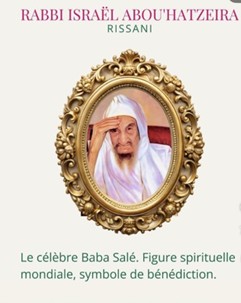
At the center of this lineage stands Rabbi Israel Abuhatzeira, known as Baba Sali (1889–1984). Born in Rissani in Morocco’s Tafilalet region and later settling in Israel, Baba Sali became one of the most revered Sephardic spiritual figures of the modern era. Jews and Muslims alike sought his counsel, blessings, and prayers; often waiting days for only a few moments in his presence.
What distinguished Baba Sali was not spectacle. He lived ascetically and avoided public display. His influence did not come from institutional authority, public teaching, or mystical performance. It came from moral gravity. Faith, in his life, was not something to demonstrate, but something to inhabit. Even as stories of healing followed him, he consistently redirected attention away from miracles and toward responsibility, humility, and trust in Hashem.
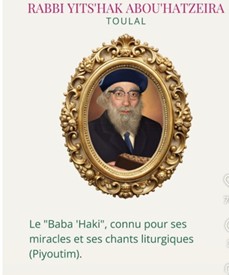
That same inheritance found a different enduring expression in his brother, Rabbi Yitzhak Abuhatzeira, known as Baba Haki (1895–1970). Where Baba Sali embodied faith through silence and restraint, Baba Haki expressed devotion through voice, text, and song. A master of piyutim, he carried the family’s spiritual posture into communal prayer and liturgy. His legacy lives in melodies still sung and words still recited. Faith transmitted through disciplined repetition and shared memory.
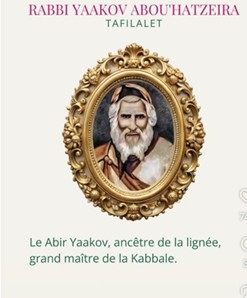
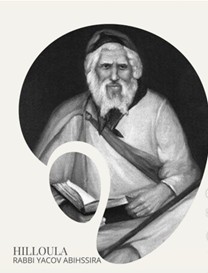
The lineage reaches further back to Rabbi Yaakov Abuhatzeira, the Avir Yaakov (1806–1880), one of the great kabbalists of North Africa. Revered for his scholarship and spiritual depth, Rabbi Yaakov passed away in 1880 while traveling toward the Land of Israel and is buried in Damanhur, Egypt. His writings continue to be studied not as artifacts, but as living guides.
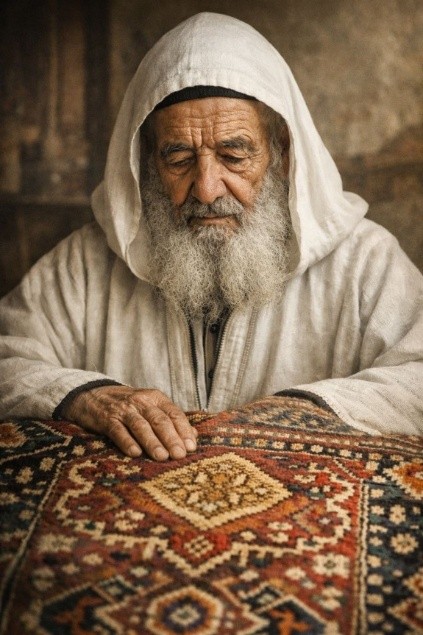
Family tradition traces the origin of the Abuhatzeira name to a story told across generations, most often associated with Rabbi Yaakov Abuhatzeira . According to the legend, when he sought to journey from Eretz Yisrael (the Land of Israel)toward Morocco without money, passage, or protection, he did not pray for resources or intervention. He prayed for trust. The story recounts that he was carried across the sea on a ḥaṣera (a simple woven mat or carpet) an image that later gave rise to the family name Abuhatzeira. In both Hebrew and Arabic, “father” is rendered as אַבָּא (Abba) in Hebrew and أبا (Abā) in Arabic, reflecting a shared Semitic root. The name is often understood as “the father of the mat.” Whether read literally or symbolically, the teaching is the same: the journey was sustained not by means, but by faith.
Within the tradition, this story was never meant to be read as fantasy. It functioned as teaching. The “magic carpet” was not an object of power, but a posture of faith: movement made possible not by force, but by alignment; not by control, but by surrender. Jewish tradition calls this bitachon—the courage to move forward without demanding certainty, and to trust that when resistance is released, the way may carry you.
That same posture appears earlier in the Torah, when Moses led the Children of Israel out of slavery and Pharaoh’s army closed in behind them. Nachshon ben Aminadav stepped into the Sea of Reeds until the water reached his neck; only then did the sea part. Faith in Hashem came first. The miracle followed.
In that light, the magic carpet is not a fantasy of flight, but a theology of movement. It teaches that redemption does not begin with certainty, but with willingness.
Like Abraham’s Lech Lecha, the story is not about arrival, but about the courage to move before the path is revealed.
Long before the “Magic Carpet” image entered popular culture, the carpet represented something quieter and more demanding: the willingness to step forward without guarantees, and the belief that when effort gives way to alignment the world itself may begin to carry you.
In the end, faith was never about flying. It was about learning how to move in alignment—without force, without spectacle, and without spilling what matters most.
Faith, in this lineage, is the courage to move before the path is revealed.
Magic carpet lifts
Faith carried through generations
Legacy in trust
The Abuhatzeira family
That inherited posture of trust finds its modern expression in Learning to Fly Without Resistance, its Torah source in They Moved Before They Knew (Lech Lecha), and its reflective echo in Below the Clouds.