
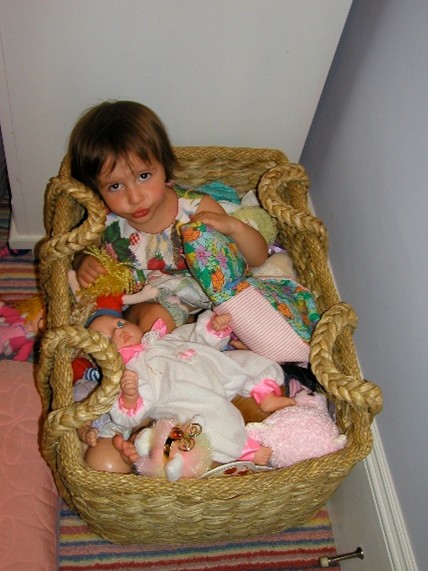
“Ready or not, here I come!”
I can still hear myself shouting those words—equal parts excitement and warning—as my daughters, then seven and four, scattered through the house looking for the perfect hiding spot. Lucy’s favorite was the doll basket—buried beneath stuffed animals, certain she had found the perfect place to disappear. The game was simple: stay hidden as long as possible. Winning meant not being found. And when I finally spotted them—behind a couch or tucked into a closet—“I found you!” marked the end of their victory and the beginning of their laughter-filled defeat.
As Passover approaches, I find myself thinking about a different kind of search.
At our Seder, the afikoman—and even the search for chametz—became highlights for the children. Unlike hide and seek, where the goal is to remain hidden, the afikoman reverses the game entirely—the goal is to be found. After years of finishing second to my older brother Laurence—never once finding it—I made a quiet decision as a parent. At our Seder, the children would search together. The reward would be shared. The experience would be about discovery, not defeat.
Our rabbi at The Shul, reflecting on this week’s Torah portion, Vayikra, brought this contrast into focus. The word Vayikra—“And He called”—ends with a small aleph, written smaller in the Torah scroll. It is a subtle detail, yet one filled with meaning. Many interpretations point to Moses’ humility—his desire to soften the intensity of God’s call.
But there is another way to understand it.
Moses is called by God three times: at the burning bush, at Mount Sinai, and here in Vayikra.
The progression is precise.
The first call awakens.
The second teaches.
The third reveals.
At first, the voice comes from outside, impossible to ignore. Then it gives structure and direction. Finally, it becomes quiet enough to be heard within.
What if the small aleph represents not less communication, but a deeper one?
Not the voice that demands attention—but the one that requires awareness.
One of our favorite children’s books was Dr. Seuss’s Horton Hears a Who!. Horton hears a tiny voice coming from a speck of dust—so small that no one else believes it exists. While others dismiss it, Horton listens. He protects it. He insists on its reality, even when it seems invisible to everyone else.
“A person’s a person, no matter how small.”
As I read to my children, it seemed like a simple story. As I reflect as an adult, it feels much deeper.
The ability to hear what others overlook, to notice what appears insignificant, is not imagination. It is perspective. As Albert Einstein observed, genius is seeing the same thing as everyone else, but thinking about it differently.
Perhaps the small aleph is asking the same of us.
It reminds me of a Hasidic story often attributed to Rabbi Simcha Bunim of Peshischa. A poor man dreams that he will find a treasure under a bridge in a distant city. After traveling there, a guard laughs and tells him that he once dreamed of treasure buried under the bed of a poor man with the same name. The man returns home, digs beneath his own bed, and discovers the treasure had been there all along.
Sometimes we travel far only to discover that what we were searching for was already within us.
As children, we play hide and seek trying not to be found. As adults, we realize that the greater challenge is allowing ourselves to be found.
This Passover, perhaps the goal is not to remain hidden, but to step forward.
We spend our childhood trying not to be found—and our lives learning how to be found.
The afikoman follows the same pattern. Early in the Seder, we transform an ordinary piece of matzah into the afikoman with a simple break. The night continues without it. And then, at just the right moment, the search begins. The children look, they uncover, they return with it—and only then can the meal be completed.
The small aleph, the afikoman, the hidden treasure beneath our own bed—they all point to the same truth: the most important parts of ourselves are not absent, but waiting.
To listen more carefully for the quieter voice.
To search more honestly for what we have set aside.
To find the small aleph within ourselves—and bring it back to the table.
Yesterday, my older daughter Caroline successfully matched in her pursuit of medical residency. I have always admired her determination and academic excellence. But what I am most proud of is something quieter.
When Caroline and Lucy played hide and seek, Caroline often chose to be found first—allowing Lucy the joy of winning.
As Caroline now begins her journey as a physician, I see that this was never a small gesture. It was an early expression of something deeper—a hidden strength of kindness. A physician enters the most hidden places in a person’s life—the moments of fear, pain, and vulnerability few want seen. Caroline has been practicing for this her entire life, not in hospitals, but in a house in Boston, in a game of hide and seek, learning that sometimes the most generous thing you can do is let someone else be found first.
As we approach this year’s Passover Seder, we can see the afikoman not as something lost, but as something waiting for us to become the kind of people who are ready to be found.
Hidden all along
We search far for what we hold
Ready to be found