I woke up inside a rain cloud.
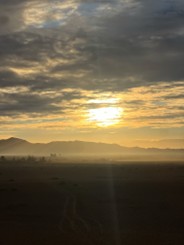
It was a surprise to discover the sun below.
On my birthday, I woke with anticipation for my tennis lesson. After two years of surgery and physical therapy, I was finally able to play again. To return not just to a game I love, but to a body I was learning to trust again.
We live on the 25th floor. When I looked out the window that morning, all I could see were clouds; thick, gray, and low. No ground, no horizon, just rain and mist. It felt definitive. I texted my tennis teacher to cancel. He replied quickly: the courts were dry, playable, and touched by a sliver of sunlight.
When I arrived, he was right. The court was bright, the ground was dry, and the sun was out. I found myself wondering how nature could hold such different truths at the same moment in places in such proximity.
In Hebrew, teva means nature. Phonetically, it is also the word used for the Ark of Noah and the basket that carried Moses. In both cases, human beings are placed into nature not as masters, but as passengers carried forward by forces they do not control. Both moments mark beginnings. Both require trust in Hashem and surrender to time and elements.
Like Noah waiting in the ark as the Flood waters receded, I came to see that clarity often appears before we can reach it.
Judaism, I realized, is a tradition anchored far more in time than in place. As Abraham Joshua Heschel writes in The Sabbath, Shabbat is a sanctuary in time independent of geography. Nearly all Jewish holidays are rooted in the calendar, not the landscape. Our faith is portable because it is tethered to when, not where.
There are rare exceptions. The Western Wall in Jerusalem grounds us in a specific place. Sukkot grounds us in a prescribed structure; only fully observed within the fragile walls of a sukkah. But even there, the lesson is impermanence, exposure to the elements, and trust.
Nature, I began to understand, is where time and place meet. It is Hashem’s interface between the two. Weather can unite distant places or divide adjacent ones. Clouds can obscure while sunlight waits just above. What we experience depends not only on where we stand, but on when, and on whether we are willing to move.
That morning, I learned something simple and lasting. Sometimes you wake inside the cloud. Sometimes the light is already there, waiting beneath it. Wisdom is learning when to descend.
Inside the cloud
Light was never gone at all
Only out of sight
The wisdom of waiting beneath the clouds is mirrored in Learning to Fly Without Resistance and rooted in lineage in The Magic Carpet Was Never About Flying.